
The Topic

Purpose:
The purpose of this article is to analyse, understand and compare, exactly how the Australian and US economy responded to the coronavirus, this is in terms of its economy, as well as look at the performance of its sharemarket throughout this period and the current situation they are in now. The main purpose of this is to clearly show the effects that a major pandemic has on the economy. The US is the country with the biggest economy in the world and also the most coronavirus cases, so it will be interesting to further see how different strategies were implemented by Trump's USA in order to support businesses and individuals, as well as the effect on their sharemarket, and how this differs to the economy of Australia, one which is relatively smaller to the US and has not as many cases, and how we have implemented strategies to support businesses and indivduals throughout this tough time.
Why is this important to know?
As this is all related to a pandemic, it is very interesting to be able to basically see for ourselves how the economy performs in the such situations. It is also important and interesting to know how different countries around the world responded to the economic crisis and negative economic effects opposed by this outbreak. This allows a further look into macroeconomics with topics such as govenrment intervention and trading in play, and allows for a better understanding with a current example.
The Coronavirus Pandemic and The Economy
The ongoing 2019-20 Coronavirus pandemic, referred to as COVID-19, is an ongoing worldwide pandemic of the Coronavirus disease. The outbreak was first identified in Wuhan, China in December 2019, and has since spread all across the world, with the World Health Organisation characterising it as a pandemic, on the 11th of March 2020. The infection has not only become a public health crisis but has majroly affected the global economy.
As of the 25th of August 2020, there are over 24 million cases worldwide. Most countries globally have entered the State of Emergency and gone under strict lockdown and social-distancing procedures, in an effort to control the spread of the virus. Currently, after the first wave of the virus hit, alot of countries have gone basically back into full routine, such as the USA, but this was influenced based on the Black Lives Matters protests and no government control over its residents in order to control the virus, as a result, it is still receiving 35,000 + cases daily, and the government has put little to no effort to contain in. The State of Victoria got hit with the State of Disaster protocols put on, after it boosted testing and found another outbreak of the virus. As a result, strict lockdown and other procedures set up by the government have overall had a negative effect on the world's economy. This is because it stopped from several industries to halt production and work, resulting in overall economic lost.
As a result, the pandemic has left many people without jobs or with major income cuts due to the coronavirus crisis. Unemployment rates have increased across major economies as a result.
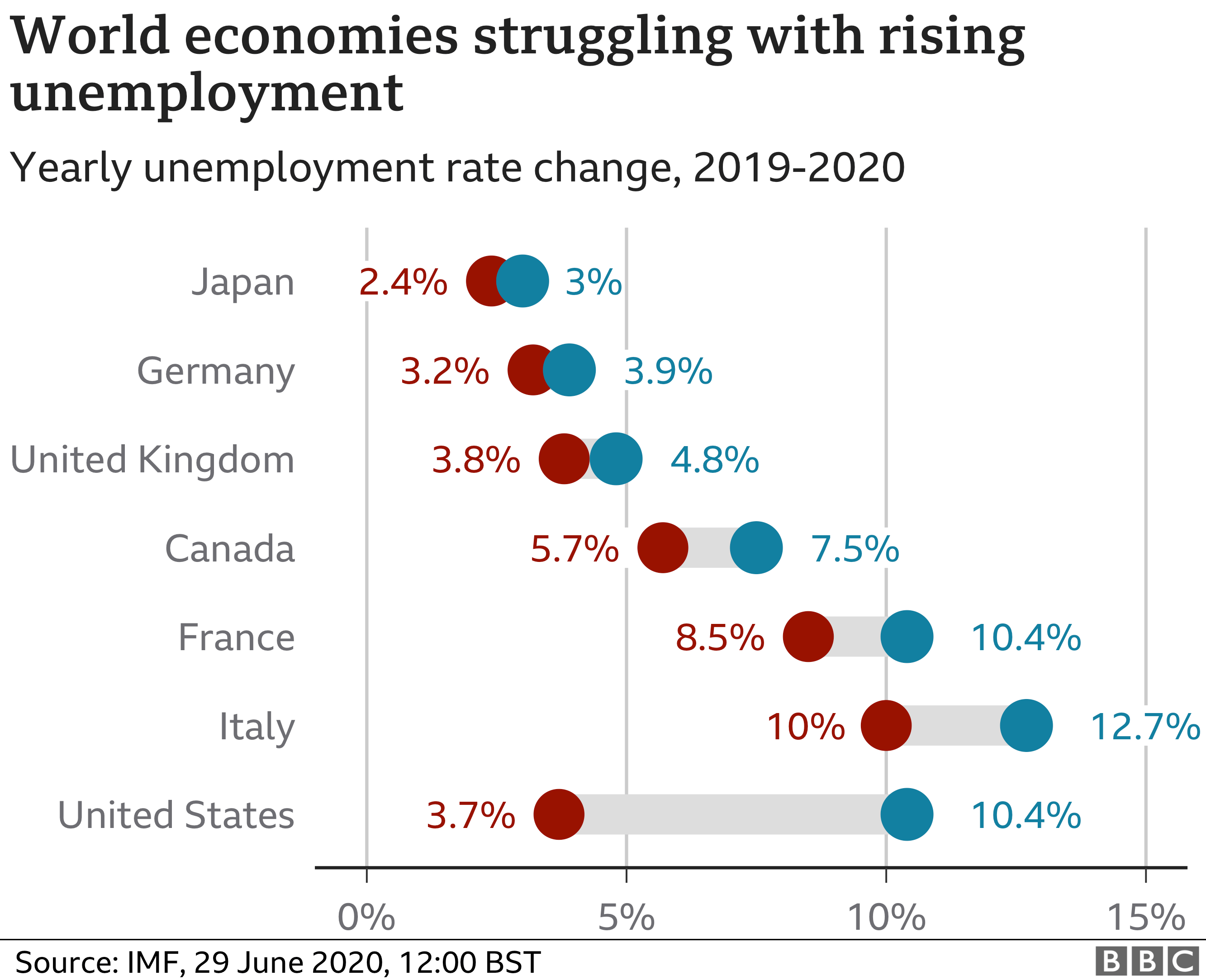
Source: Bloomberg, 30 June 2020

Around the world, countries have adopted various ways to reduce these rates, for example in some countries, such as the UK and France, millions of workers have been put on government-supported job retention schemes, such as in the tourism, transport and hospitality industries, as major industries came to a standstill under lockdown. Another example is the JobKeeper Payment scheme implemented across Australia, this program is designed to help business affected by the coronavirus to cover the costs of their employees' wages, so that more employees can retain their joband continue to earn an income inorder to support themselves and their families.
Overall effect on the Stockmarket
For the purpose of this study, all stockmarkets around the world will be looked at from a 6 month window (2nd March 2020 till 31st August 2020).
Part of the economic impact of coronavirus was that it caused for big shifts in stock markets around the world. Three of the biggest stock market indexes around the world; the FTSE (London), Dow Jones Industrial Average (New York) and Nikkei (Tokyo), all saw huge falls as the number of Covid-19 cases grew around the world. The Dow and the FTSE saw their biggest quarterly drops in the first three months of the year since 1987.
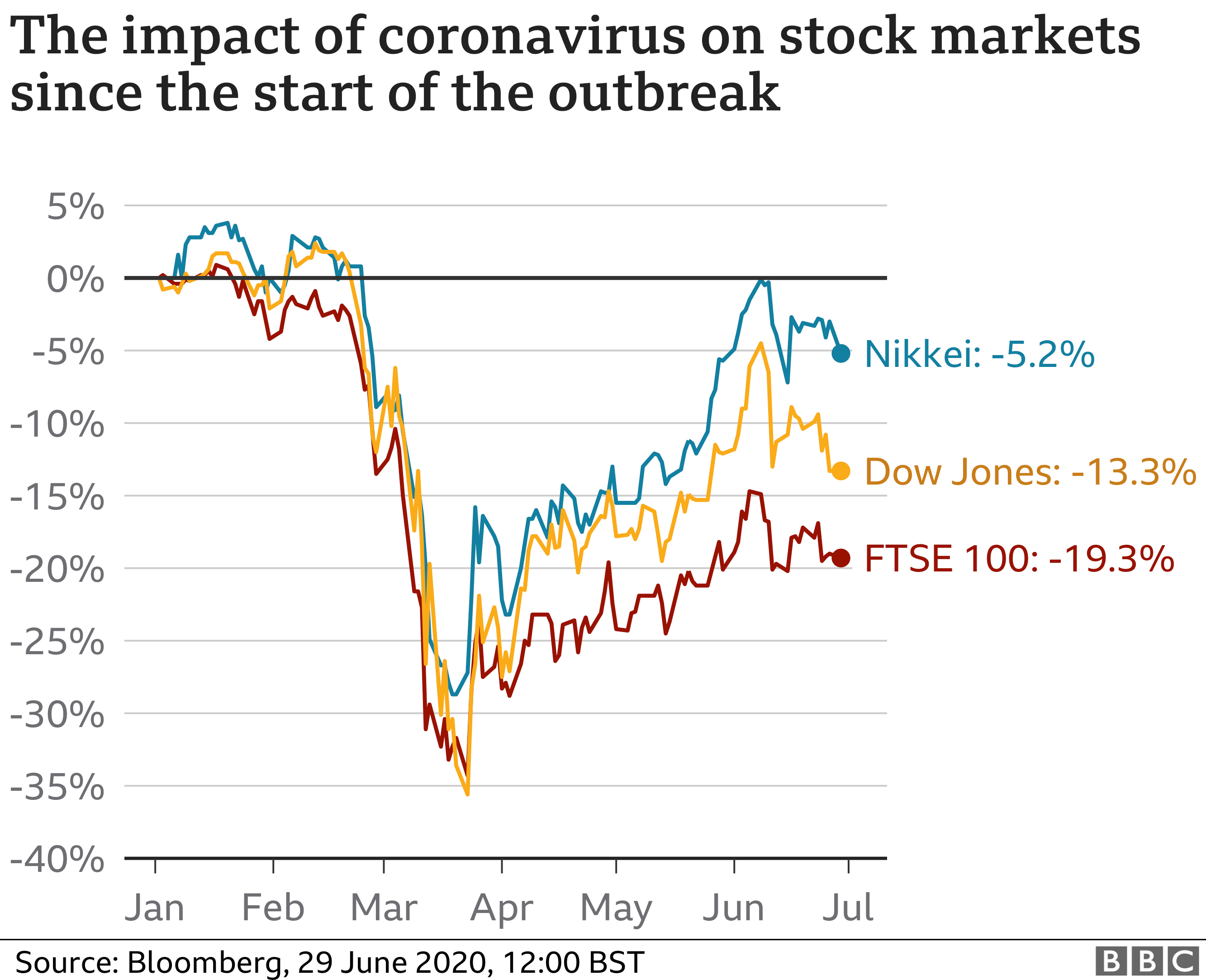
Source: Bloomberg, 29 June 2020
In response to major drops, central-banks in many countries around the world, slashed interest rates. Slashing interesting rates, in theory, should make borrowing cheaper and encourage spending to boost the economy. However, this overall effect seemed to be very minor, as global markets since recovered quite quickly as governments intervened. However, with further waves of the coronavirus still lingering and no proper vaccine to be discovered, knock-on negative effects to the economy has left stock markets to still be volatile (liable to change rapidly and unpredictably) until fears of further waves of the pandemic have properly eased.
Australia and the Coronavirus
Mid-way through March, cases started taking an unexpected rise in Australia. Previously, the country was recieving around 20-40 cases daily, but it was controlled and the breakouts of the virus were known. From the small 20-40 daily cases, the Australian Government had already taken a course of action to restrict tourism and block flights from many countries from entering the country.
Victoria, however at the time better off and had less cases then New South Wales and Adelaide, was the first state to take major course of action, with Premier Daniel Andrews declaring a State of Emergency for the next month, which was subsequently extended. Other states followed, with appropriate actions taken by each one, however tougher restrictions were placed for Victorian residents.
By mid-March the World Health Organisation had declared a global pandemic, the Government had announced two seperate stimulus packages, and the Reserve Bank of Australia (RBA) had announced plans to implement a comprehensive package of measures to support economy and promote functioning of key financial markets, as well as social distancing restrictions to limit the spread of COVID-10 had been implemented.
A total of $194 billion was injected into the economy by all arms of the Government in order to keep Australians in work and businesses in business. This included $17.6 billion for the Government's first economic stimulus package, $90 billion from the RBA and $15 billion from the Government to deliver easier access to finance, as well as a second $66.1 billion economic support package from the Morrison Government.
In terms of the the economic stimulus packages, these included funds going towards:
- Support for works and households: including casuals, sole-traders, retirees and those on income support.
- Assistance for businesses to keep people in a job
- Regulatory protection and financial support for businesses to stay in business
Each of these are expanded below, into exactly how the government achieved this.
In terms of the support for workers and households by the government through the Economic Stimulus Packages released, these were split into 5 parts.
1. Coronavirus Supplement
-The Government temporarily expanded the eligibility to provide income support payments, and establishing a new, limited, coronavirus supplement to be paid at a constant rate of AUD$550 per fortnight. This was to be paid to both existing a new recipients of the following forms of Government Support: JobSeeker Payment, Youth Allowance JobSeeker, Parenting Payment, Farm Household Allowance, and Special Benefit.
This Coronavirus Supplement is to be paid until the 31st December 2020, and could be further extended if a third wave strikes and causes for more economic damage. The Government estimated for this supplement to cost them over $14.1 billion over the period. To keep some people active in jobs, an increase of up to 5,000 staff per state were employed / hired for Services Australia, in order to assist in delivery of new Government Measures.
As can be interpreted by the graph above, businesses did not intend to register for the JobKeeper Payment scheme (33% of all businesses) the graph below shows the reasons for not registering for the JobKeeper Payment scheme, by employment size.
2. Payments to Support Households
- In addition to the $750 stimulus payment announced on 12 March 2020, the Government will provide a further $750 payment to social security and veteran income support recipients, as well as eligible concession card holders (such as a Health Care Card), except of those who are already receing an income support payment that is eligible to receive the Coronavirus supplement. However, these payments were quite infrequent, with the second payment being made 2 months later, as these were additionaly to the $750 stimulus payments received. This measure taken estimated to cost the government over $8 billion over the estimated period.
3. Early release of superannuation
- Another measure taken by the Government, was that they allowed individuals in financial stress as a result of the Coronavirus to access up to $10,000 of their superannuation in 2019-20 and a further $10,000 in 2020-21. The individual would not need to pay tax on amounts released and the moeny thew withdraw will not affect further their Centrelink or Veterans' Affairs payments. This measure taken estimated to cost the government over $1.6 billion over the estimated period.
4. Temporarily reduce superannuation minimum drawdown rates
- Further with superannuation, the government took a measure to temporarily reduce the total amount of supperannuation drawdown requirements for account based pensions and similar products by 50 percent for 2019-20 and 2020-21. The purpose of this measure was to benefit retirees by providing them with more flexibility as to how they manage their superannuation assets.
5. Reducing social security deeming rates
- The final measure enforced by the government, was that on top of the deeming rate changes made at the time of the first package, the Government reduced these deeming rates by a further 0.25 percentage points to reflec the latest rate reductions made by the RBA. On the 1st of May 2020, the lower deeming rate was set to 0.25 percent and the upper deeming rate will be 2.25 percent. A deeming rate is the amount the government deems your income to be from your financial assets. This calculation is used for the pension income assessment, and can affect how much someone recieves through their pension. This change is to benefit more than 900,000 income support recipients, including Age Pensioners. This measure is estimated to cost $876 million over the estimated period.
Boosting Cash Flow for Employees
Boosting Cash Flow for Employees was the main way the government assisted businesses to keep people in their respective jobs. The Australian Government provided up-to $100,000 to eligible small and medium sized businesses, and for non-profit organsiations, including charities, that employ people, with a minimum payment of $20,000. These payments were provided to help businesses' and not-for-profit' (NFP) cash flow so they can keep operating, pay their rent, electricity and other neccessities needed to keep them businesses, as well as retain staff. Under the enhanced scheme, from the first package, employers will recieve a payment equal to 100 percent of their salary and wages withheld (up from 50%), with the minimum payment being increased from $25,000 to $50,000. In addition, the minimum payment is being increased from $2,000 to $10,000. By linking the payments to business to staff wage tax withholdings, businesses are incentivised to retain more workers. The payments made are tax free. This measure will benefit around 690,000 businesses employing around 7.8 million people, and around 30,000 NFP organisations. This measure is estimated to cost $31.9 billion over the forward estimates period, including the value of the measure announced in the first package.
In terms of providing regulatory protection and financial support in order to keep businesses in businessm, three seperate measures were established by the government.
1. Coronavirus SME Gurantee Scheme
- The Government established the Coronavirus SME Gurantee Scheme was created by the Government to support small and medium enterprises (SMEs) to access to working capital to help them get them through the impact of the coronavirus. Under the scheme, the Government will Gurantee 50 percent of new loans issued by eligible lenders to SMEs. The Government's support will enhance lenders' willingness and ability to provide credit to SMEs with the Scheme being able to support $40 billion of lending to the businesses/enterprises.
- The scheme will complement the announcement the Government has made to remove the barrier to allow SMEs to get access to credit faster. It also complements announcements made by Australian banks to support small businesses with their existing loans. This builds on the investments made by the government in order to enable smaller lenders to continue supporting Australian consumers and small busineses. This further supports the Reserve Bank of Austrlaia's announcement of a $90 billion term funding facility, that will reduce the cost of lending, with particular incentives to len to small and medium enterprises. The government has guaranteed up to $20 billion to support $30 billion in SME loans.
2. Providing Temporary Relief for Financially Distressed Businesses
- The Australian Government tmeporarily increased the threshold at which creditors can issue a satutory demand on a company and the time companies will have to respond to stautory deamnds they recieve. A creditor's statutory demand is a letter of demand served by creditor to a debtor company in an attempt to recover debt owed to a creditor. The package also includes temporary relief for directors from any personal liability for trading while insolvent.
This builds on the support for business and business investment provided in the first economic support package, the contents of all of these include.
- Increasing the instant asset write off
- Backing business investment by providing accelerated depreciation deductions.
- Supporting Apprentices and Trainees
- Targeted support for coronavirus-affected regions and communities.
3. Support for the aviation industry
- With the coronavirus, the most affected major industry would be the aviation industry, this is due to travel restrictions and an overall slump in demand among travelers, which has overall effected in a turn around and massively reduced revenues for airlines. The Government announced a package providing up to $715 million in support for Australian airliens and airports, this is to help ensure that the aviation sector receives timely cash flow support thorugh an unprecedented period of disputon to international and domestric air travel. The federal government will also waive all fees and levies owed to the government by the airpots and airlines and reimburse the airlines the $159 they already collected this year.
For this analysis, the main major market index used in the Australian share market will be referenced to, this is the S&P/ ASX 200, which is an index made up of the top 200 shares in the ASX. Some notable companies include Commenwealth Bank, Woolworths, Telstra and Qantas.
The graph below, shows the performance of the ASX 200 Index over the past 6 months and the impact that the coronavirus has had on its performance.
As it can be seen, nearing the end of March, when many states had enforced hard restrictions which would overall effect business's and Qantas had announced on the 19th of March, confirming that 60% of its domestic flights were to be suspended, two-thirds of its employees were to be put on leave, suspend all international flights and ground more than 150 of its aircraft from the end of March, following closely the expanded government travel restrictions imposed.
As can be seen by the Qantas Stock (ASX: QAN), the stock reached a low in the 6 month period,rapidly falling by ≈ 60% since the start of March, the knockon effect from the announcements made by the Government about travel restrictions, and Qantas about it suspending flights and other courses of action taken.
For a more thorough understand, lets analyse this graph which shows the performance of the S&P / ASX 200 from February 19 to March 31, with reference to key points throughout the period.
Analysing this, the ASX 200 Index reached its all time high, closing at 7162 points on the 20th of February, this was rather suprising as the deadly coronavirus hadn't rattled the stockmarket on initial impact, as strong tech companies were causing the index to boom recently. However since then the stockmarket went into a decline. When more virus cases were reported outside of China then China had reported, the market started to slowly shrink, with it going down 2.3%. However, the major down effects hadn't come until the WHO declared it as a pandemic, which caused for the market to enter bear market status, and in response, Australian states took matters into their own hand and imposed different procedures, like Victoria implemented strict lockdown, causing for businesses to shut and stop production in many markets.
Since then, the ASX 200 hasn't overall recovered, still being down 5% since the start of March, when refrencing the ASX 200 graph above. It has been a bumpy road, as many businesses have started to fully operate again and the pandemic is still fearing further waves. On top of that, Australia has officially gone into recession for the first time since 1991, as the GDP falls 7% in June, all thanks to the knockon effects of the coronavirus.
Currently, the coronavirus outbreak has been controlled in most states in Australia, except for Victoria which is under the State of Disaster protocols and has experienced the worst numbers in the country.
Initial Response by Australia
America and the Coronavirus
Support for workers and households

Source: Grattan, 26th May 2020, reproduced by ABC
This graph shows exactly how the total $194 billion was split in order to provide economic support to Australia

Source: Australian Bureau of Statistics, 4th May 2020
This block-chart above shows the relative share of each industry division of total jobs. The figures witin segments represent the proportion of businesses in each industry that have registered or intend to register for the JobKeeper Payment scheme

Source: Australian Bereau of Statistics, 4th May 2020
Assistance to Business to keep people in a job
Regulatory protection and financial support to businesses to stay in business
Effect of Coronavirus on the Australian Stockmarket

Source: Google, 3rd September 2020

Source: Google, 3rd September 2020

Initially, on the 31st of January, the US outbreak of the coronavirus was declared a public health emergency and restrictions were placed on flights from arriving from China. The initial U.S response to the pandemic was rather slow and non well thought out, this is in terms of preparing the healthcare system, stopping travel and movements and testing for the virus. The US President Donald Trump, firstly downplayed the threat posed by the virus, calling it fake and claiming it was "under-control".
It didnt't take long for Trump to take back his words and declarling a national emergency of the 13th of March, although at the time they had a total well over 10,000 this decision should've seemingly come earlier. But Trump's administration watied for large quantities of medical equipment. The Defense Production Act, under which presendential authorisites can expand the supply of materials and services from the U.S by directing industries to produce certain goods, ultimately to promote their national defense, but in this case, to produce medical supplies / equipment, to help control the virus's outbreak.
However, through the initial lockdown imposed by the Trump Government, alot of residents were angry who simply did not understand the severity of this virus and were protesting against lockdown, saying it was ruining businesses, although the President had announced support for them businesses. This caused for a further spread of the virus through protests and people refusing to follow orders.
Another major event which had an impact on the spread of the virus, was the unfortunate circumstances leading up to the murder of George Floyd. The amount of murders made by cops against people of color sparked an outrage on how people of color, particularly African American, were being treated in the United States. This lead to massive gatherings and protests all across the country for people to get their voices heard and caused for an incline in the number of cases happening, with no real solution and the government basically giving up.
In response, President Donald Trump annoucned an unprecedented relief package, which totals more than $2 trillion. Below is how this was split up to support Works and Households, as well as businesses.
Through Economic Impact Payments and other means, the American Treasury department helped ensure that Americans recieve fast and direct relief payments in the wake of the pandemic.
1. One part of the act aimed to provide tax free payments to American Families
The amount of money dependently heavily on the current financial situation of the family itself.
- If a couple were jointly earning up to $150,000, they would recieve $2,400 in the first Stimulus Payment, plus an additional for $500 for each child they have.
- If an individual is earning up to $75,000 will receive $1,200, plus an additional $500 for each child.
2. The legislation also provided assistance to Americans who were out of work.
- The act allowed for unemployment benefits to be increased for individuals, and for them to receive fedral reimbursement for the additional amount. A new program was also created to help financially assist the self-employed and independent contractors who are unemployed due to the pandemic.
3. The legistlation also provided relief for homeowners and renters.
This part of the act helped ensure that Americans' homes are not threatened by the coronavirus. This was acheived by enabling payment forbearance for federally backed mortgages. A forbearance is a temporary postponement of mortgage payments, it is seen as a form of repayment relief granted by the lender or creditor in lieu of forcing a property into foreclosure, or in this case, in the wake of a pandemic.
4. Further acts which were taken include
- Suspending penalties for people with retirement accounts for withdrawing amounts more than $100,000
- Provide $3.5 billion in emergency funding to child care serivces to stay open, keep payroll and prioritize child care needs in terms of healthcare, emergency, and sanitation workers all across the country.
This part of the legislation act, aimed to strengthen the US economy by providing financial assistance to America's small businesses and workers.
This was acheived by the following, several measures were placed by Trump's Government.
1. Small to Medium Businesses Support
- The Government's intervention from the US will come in a ways for businesses. Midsize companies (between 500 to 10,000 employees), get to borrow any money required at an interest rate that is not higher than 2% annually, and don't have to repay principal or interest for upto six months. However, as a result, these companies cannot "outsource or offshore" jobs from the start of the loan until two years after it has been repaid, which can be seen as a major inconvenicence for many businesses who wish to deal internationally.
- Smaller businesses, those of 500 employees or lower, would get loans directly from banks to cover more than two months of payrolls and some other operating expenses, with the government paying off the balance so long as the companies do not lay off workers.
2. Support for aviation industry.
- The US Government injected more than $60 bilion into the airline industry, including $25 billion in grants to pay employees of passenger airlines and $5 billion for those who work at cargo airlines. About $17 billion has been set aside largely for Boeing, which, because of two deadly, was troubled before the virus brought many commercial flights to a standstill.
As can be seen above, Boeing, which manufacturers most airplanes in the world and also hosts cargo flights and services, had a very big downfall for a company of its caliber, as the whole aviation industry has bought to a halt due to this pandemic.
For this analysis, the major market index used in the American share market will be referenced to, this is the Dow Jones, which compromises of the 30 largest companies listed on the stock exchanges in the United States. Some notable names include Apple, Boeing, Coca-Cola and Nike.
The graph below, shows the performance of the Dow Jones Index over the past 6 months and the impact tha the coronavirus has had on its performance.
Around the same time Trump announced restrictions and alot of industries were being questioned, the Dow Jones saw its biggest drop ever. This is purely thanks to the Coronavirus, as it grew fears in people's mind of uncertainty and drove fears that the pandemic will push the global economy into recession. Since then, the Dow Jones has been been performing quite well despite fears and USA being the epicentre of the whole pandemic, and has made steady progress and is looking to climb to an all time high soon.
Support for Workers and Households
Initial Response by the US

Source: Vox, April 9th 2020
The bar graph above shows in which industries jobs were exactly vulnerable of being affected by the Pandemic
Bolstering the Economy- Supporting Businesses

Source: Google, 3rd September 2020.
Effect of Coronavirus on the American Stockmarket

Source: Google, 3rd September 2020.
Summary + Personal Opinion
In my opinion, Australia has done a better overall job in providing economic support to individuals, households and businesses. Although on paper the USA has larger numbers and there stockmarket has a made a better recovery, this is simply only because they are a much larger economy and have more money able to spent in relief packages, and also have alot larger of a population to cater for.
To put these key numbers into perspective, Australia has a population of approximately 25 million, compared to America's 331 million people, a population 13 times larger. The value of the economic stimulus package was $194 bilion by Australia, whereas the US package was valued at $2 trillion, a package worth 10 times more.
When researching this, I came to the conclusion that Australia had done a better overall job basically due to the amount of funding it was providing its residents and the frequency. For example, the $3400 per family stimulus check was a one-off payment, which was given twice to residents, whereas with the JobKeeper program, $750 was distributed as an individuals wage as a weekly payment, and added benefits such as the Child Care support and concession payments were also boosted, providing families with more money, as well Australian banks being more willing to defer loan payments. Although not entirely evident, the Australian government did a better job in encouraging frequent household spending, although under tough restrictions with these payments, this is however not evident due to the economy receding, but this is soely due to the overall effect on major industries in Australia, such as the aviation industry.
In terms of small and medium-sized businesses, a strong case can be argued for each side. However, America's support came in the form of loans with strict restrictions, such as companies not being able to outsource or offshore business for a further two years, which is a major inconvenience for the busiensses who wish to deal internationally, which made government loans are lot more unattractive and therefore many businesses not taking them at the time as it seemed like a major flaw. Australia had more direct involvement with the businesses, flushing money into businesses themselves inorder to keep or boost the cash flow of those businesses alive and prevent much overall loss.
In reference to the stock markets, on paper the American stockmarket has been better. From the Dow Jones at an all time low at the start of the year and making a remarkabley quick recovery back to positive figures, it has been quite impressive. The Australian sharemarket is still suffering a lost over the past 6 months or so and has been struggling to recover over the time due to the road of recovery still being ahead of us and alot of industries still suffering. The main reason the Dow Jones was able to make this recovery was mainly due to the fact it is home to all these big brands which still have some output in many countries around the world. An example could be Apple, although it may not be highly appropriate to purchase such devices at the current time, it still has somewhat of a demand due to "Work from Home" agendas and Amazon also booming, as its services have been utilised much more during this lockdown period for people to purchase goods.
Although saying this, America also didn't really follow the laws it set, which is the main reason they are still experiencing approximately 40,000 cases daily. People returned to work quicker, industries fired back up quicker, which helped it recover economically much better than Australia during this time. Australia has entered recession due to suffering the economic fallout from the coronavirus, with the economy reportedly being previously weak, it is a long road ahead for Australia in order to exit recession, something we may not see for a further year or so.